Latest Post
Showing posts with label Temples Of Egypt. Show all posts

Temple of Madinat Habu

The Temple of Medinat Habu is one of the largest memorial Temples in Egypt. It measures 320 m in length (East to west) and about 200 m in width (North to south). It was built to commemorate Ramses III, after his death, by orders of the King himself. A huge mud brick enclosure wall surrounds the Temple. 
This building basically consists of a huge gate, which takes the shape of a Syrian fort, and is decorated with battle scenes of the King's wars in Syria. After accessing the gate there is a shrine, which dates back to the 18th Dynasty, on the right hand side. There is also a wide-open court that leads to a huge pylon, which has both towers decorated with battle scenes. On one tower the King, wearing the red crown with his "Ka" or "double", smiting his enemies in front of Re-Horakhty. On the other tower, the King is represented with the red crown of Lower Egypt, smiting his enemies in front of the God Amon Ra. 
One of the most wonderful scenes engraved on the back of the southern tower, is the oxen hunt, which depicts Ramses III, leading his chariot, hunting wild oxen. Here you will notice that the sculptor was very skilful in showing the pain of the wounded animals. 

The 1st open court measures 42m long by 33m wide. Its walls are decorated with battle scenes fought against the Syrians and the Libyans.
The 2nd courtyard (42m long by 38m wide) was converted into a basilica in the early Christian times, but there are scenes representing religious ceremonies, especially the festival of the Gods Sokker (also spelt Sokar) and Min. Other scenes represent the King, with the priests, making offerings to various deities. 
The 1st Hypostyle is badly damaged, probably by an earthquake in 27 B.C. It contained 24 columns in 6 rows, surrounded by 16 chapels: 8 to the right and 8 to the left. Among the most important shrines on the right side are the first one, which was dedicated to King Ramses III, chapel number 2, which was dedicated to the God Ptah, chapel number 4, which was consecrated for the boat of the God Sokker, and chapel number 7 which was dedicated to the sacred boat of the God Amon Ra. 


The chapels on the left side were dedicated to storing the utensils of the Temples, except for chapel number 14, which was dedicated to the sacred boat of King Ramses II, and chapel number15, which was dedicated to the divine boat of the God Montho.
The 2nd Hypostyle hall contains 8 papyrus columns in 2 rows.  The 3rd Hypostyle hall is similar to the 2nd Hypostyle hall and its ceiling was supported by 8 columns in 2 rows.


At the end of this hypostyle hall there are three entrances, the one in the centre leads to the sanctuary where the sacred boat of Amon Ra was placed, the one to the right side leads to the chapel of the God Khonso while the one of the left side leads to the chapel of the Goddess Mut.
The Sanctuary at the end of the Temple consists of 3 chapels as mentioned before; it was dedicated to the “Triad of Thebes”, and was surrounded by many side chambers.


Temple of Abu Simbel

The Temples of Abu Simbel are amongst the most interesting Pharaonic Temples. Located close to the southern border with the Sudan, it is 280 km south of Aswan and consists of two, rock-cut Temples, which both date back to the reign of King Ramses II (1290-1223 BC). Unfortunately these unique Temples suffered from the raising water of Lake Nasser while the High Dam was being built. Other countries, with the help of UNESCO, assisted Egypt to help save them.

The two Temples were cut in to many pieces, and then they were reconstructed again on a site 65m higher than the original location, and 200m back inland, to escape the rising water level. This great rescue operation began in June 1964 and finished in September 1968.
The first Temple was built by King Ramses II and is dedicated to the God Re-Hor-Akhty, Amon, Ptah, and King Ramses II as a deified King. Its façade is 35m long and 30m high.The façade has four seated colossi of the King; each one is 20m tall and represents the King seated on his throne wearing the double crown,accompanied by 3 small figures of his wives, daughters and sons flanking his legs.
Above the entrance stands the figure of Re-Hor-Akhty, while near to the summit of the façade there are number of baboons.
Inside the Temple there is a hall, supported by Osirid shaped pillars which were cut into the rock, with walls that are decorated by battle and offering scenes. There are some side rooms leading from the hall, which are also decorated with various scenes. At the far end of the Temple is the sanctuary, which contains four statues; Re-Hor-Akhty, Amon-Re, Ptah and the deified Ramses II. 


The Temple of Nefertari
The Temple of Queen Nefertari is located 120m from the Temple of Ramses II and was also built by Ramses II, dedicated to the Goddess Hathor and to his wife Queen Nefertari. Queen Nefertari was the principal, and the most beloved, wife of King Ramses II. It is also a rock-cut Temple with a façade of about 28m long and 12m high, which contains 6 standing colossi, each one being about 11m in height. Four of them represent Ramses II and the other two represent Queen Nefertari, each is accompanied by two smaller figures of their children.

The entrance leads to a square hall, which is supported by 6 Hathor-headed pillars decorated with scenes depicting the King and the Queen making offerings to different deities. 
At the end of the hall there is a doorway leading to a transverse vestibule decorated with scenes of King Ramses II making offering to Re-HorAkhty, while the Queen is presenting flowers to Khenum, Sat-tet and Anket.
The Transverse Hall leads to the Sanctuary, which contains a niche in the rear wall with a statue of Goddess Hathor, as a cow, protecting Ramses II.


Temple of Esna

Esna is about 485 miles (776 Km) south of Cairo and lies on the west bank of the Nile. It was the ancient city of Senat, called Latopolis by the Greeks. The "city of the fish" where the Nile perch was worshipped. Today it is very famous for its river barrage and as a result, it is a stop over for most of the cruise boats. The Temple of Esna, which was buried beneath its own debris for many centuries, is located in the centre of the town, close to the River Nile and only a short walk from your boat, through the local market.
To reach the Temple you have to descend a flight of steps, but be careful! They are very steep! The admission fee is EGP 35.
The Temple is dedicated to the ram headed God Khnum, the God of creation. Tuthmosis III laid the foundations of the Temple in the 18th Dynasty, but Ptolemaic and Roman Emperors, from 40-250 A.D, completed it, and their names are recorded all over the Temple walls.
The remains of the Temple contain a hall of columns, with 24 pillars, beautifully decorated with lotus and palm capitals. The walls are covered with 4 rows of relief's, showing Ptolemaic and Roman Emperors dressed in Pharaoh costumes, sacrificing to the God of the Temple. On both sides of the Temple entrance there are chambers that were used by the priests and keepers of the Temple as storerooms.
Flanking the entrance to each room, you will notice the Emperor Trajan, carried in a litter by six Priests, with jackal and hawk masks of the Gods.
The most interesting scenes in this Temple are the ones you will find on the roof, which is decorated with astronomical representations. On the left side of the gateway of the Temple you can see the sky Goddess Nut, the Dog Star, Orion's belt, and Alpha Draconis (or the Dragon Star).
On the western wall of the façade of the Temple you can see the God Horus, God of victory, and the God Khnum, dragging a net full of fish from the Nile, as well as relief's of birds. Significantly at the foot of this representation is the last known hieroglyphic inscriptions ever recorded, completed by the Roman Emperor Dios in 250 A.D


Temple of Philae

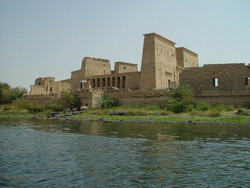
Philae Island was a rocky island in the middle of the River Nile, south of Aswan . It was called in Hieroglyphic "Apo" which means Ivory. It was also known by the Greek "Elephantine", most probably because it was an important centre of trade, especially for ivory.


The Ancient Egyptians built a beautiful and magnificent Temple on this island for the Goddess Isis, but the Temple became submerged after the first Aswan dam was built in 1906, and it was not until the seventies that many nations attempted to save the Temple. All these countries, together with UNESCO, selected a suitable place, but they had to wait until the completion of the High Dam, in 1971, which would stabilize the level of the water around their chosen island.


The new island was calledEgilica (also called Agilika), and it was completely reshaped to imitate Philae Island as closely as possible. 


Firstly, a coffer dam was built around the Temple and the water was drained. Next, the Temple was dismantled and transferred, stone by stone, from the submerged Philea Island to the redesigned Egilica Island. Each and every stone had to be numbered, and then replaced, in the same position, in the new location. It was a massive, and very complicated, project taking over 9 years to be accomplished.
The Temple of Philae was reopened in 1980!

The Temple of Isis
The Temple of Isis is one of the greatest Temples in Egypt and it occupies about a quarter of the island. It is the main Temple on the island, with its huge, complete, pylons and beautiful scenes.
The construction began during the reign of King Ptolemy II, and then other Ptolemaic Kings (Ptolemy's IV, V, VI, VII and XI) contributed by adding more parts to the main Temple.
The Temple is built in the same style as the Temples of the New Kingdom, as well as some other elements, which appeared in the Greco-Roman period, such as the Mamisi (the House of the divine birth of Horus), and a Nilometer.
The Temple of Isis consists of The 1st Pylon, which is a great traditional pylon with two towers, and an open forecourt, which leads to the 2nd pylon.

On the left side of this court is the Mamisi, which has scenes depicting the birth of the God Horus by his mother Isis.
The 2nd Pylon leads to a Hypostyle Hall with 10 columns, and then 3 vestibules leading to a sanctuary.
The oldest remains, of the Temple of Philae, date back to the reign of King Taharqa (25th Dynasty), who built the first chapel for the Goddess Isis.
In addition to the main Temple of Isis there are other monuments here, such as The Kiosk of Trajan, the Chapel of Osiris, The Temple of Horus, The Temple of Hathor, The Gateway of Tiberius, the Gateway of Diocletian, and the Temple of Augustus.
The Temples of the island were neglected, and some of them even destroyed, after the persecution of the Christians by the Roman Emperors. During the reign of the Emperor Justinian (527-565 A.D), the main Temple was converted to a church. 


The Temple of abydos

The Temple of Abydos is located to the west of El-Baliana, which is a town in Sohag Governorate. In ancient times it was called Abdu, and the Greeks called it Abydos.  Abydos, the 8th province in ancient Egypt, this area is considered to be amongst the most famous archaeological sites.  It was the city were Menna, the unifier of upper and lower Egypt came from and from the 11th Dynasty onwards, a burial in Abydos was the ultimate wish and honor for any local to have. In Abydos, many tombs were found belonging to the 1st and 2nd Dynasties. Also, many Kings  have built Temples here, including King Pepi I, King Ahmose I, King Seti I and King Ramses II.
Ancient Egyptians believed that the tomb of Osiris, the “God of the Dead, and the underworld” was located in Abydos, and it is where his head was buried.
The Temple of Seti I:

The Temple was built During the reign of King Seti I and was finished by, first, his son  Ramses II and then followed by his son, King Mern-Ptah

This temple is  quite unique in design,  as has a  shape of an “L” letter upside down. It also contains the most complete lists of Kings and Gods. The Temple contains 7 shrines dedicated to 7 Gods: Osiris, Isis, Horus, Amon Ra, Ra HorAkhty and Ptah, and Seti I as a deified King. in this temple one will  find the best-preserved painted reliefs and texts from the 18th Dynasty.
The Temple of Abydos was constructed with white marble and once had a large pylon built by Ramses II.
The front of the Temple is a square columned façade and there are 12 rectangular pillars with decoration of Ramses II welcoming the Gods Osiris, Isis and Horus. The Temple originally had 7 gates leading to 7 shrines originally constructed by Seti I, but Ramses II made additional parts to the construction, and only there is one gate open now. 

This gate leads to a hypostyle hall, which was built and decorated by King Ramses II, where the columns are decorated with papyrus bud capitals. There are many representations of Ramses II offering to many Gods, here.
 
Further west, you will find the second hypostyle hall, which is the more impressive! Seti II built this hall, the walls depicting Seti I giving offerings, to Osiris and Horus, in front of Osiris shrine. The decorations in this hall are the best
in the Temple; the fine painted relief being of the highest standard. 

Behind that hall there are 7 sanctuaries, dedicated by Seti I, and made for Osiris, Isis, Horus, Amon Ra, Ra HorAkhty, Ptah and Seti I as a deified King. It is believed that these shrines once contained the sacred boats of the God's. Each of them has false doors (except for Osiris) with a Stella mentioning the God.  The shrine of Osiris doesn't have a false door; it has representations of the God Osiris’ Jed sign (the pillar of Osiris), with scenes of the Osiris myth.
 To the left of the 2nd hypostyle hall, there are two entrances. One leads to the hall of Sokker and Nefertum, while the other leads to a narrow decorated hall, with a list of 76 Kings. Missing from this list are the names of the “heretic King”, Akhenaton, and Queen Hatshepsut.
 This corridor leads to the hall of sacred boats, where the sacred boats where stored, there was also a hall for sacrifices, where the animals got slaughtered.
 

Temple of The Ramesseum

Temple of the Ramesseum was built by Ramses II the as a funerary Temple in 1304-1207 B.C, and it was dedicated to the God Ra. Most of the Temple is in a very bad condition nowadays, or in ruins. The entrance to the Temple once had two pylons that have now collapsed. In the first courtyard, of the Temple, there is only a colonnaded hall that has survived.
In front of the ruins of the first pylon, there once stood a colossal statue of Ramses that was more than 1000 Tons in weight and 18m high! You can still see the remains of it today.
Many other Kings have superimposed monuments in the Ramesseum such as Mernptah and Ramses III.
The Greeks identified this as the Temple of Memnonium (they associated the colossal statue in front of the Temple with their legendry hero, Memnon, the son of Aurora who's mother, Eos, was the Goddess of dawn. Also they sometimes called it "the tomb of Ozymandias", a name that might have be derived from the ancient Egypt word "User-Maat-Ra".


This huge Temple later inspired a poetic verse by Percy Bysshe Shelley: -
I met a traveller from an antique land
who said: Two vast and trunkless legs of stone
stand in the desert. Near them, on the sand,
Half sunk, a shattered visage lies, whose frown,
And wrinkled lip, and sneer of cold command,
Tell that its sculptor well those passions read,
Which yet survive, stamped on these lifeless things,
The hand that mocked them, and the heart that fed,
And on the pedestal these words appear:
"My name is Ozymandias, King of Kings:
Look upon my works, ye Mighty, and despair!"
Nothing beside remains. Round the decay
of that colossal wreck, boundless and bare
the lone and level sands stretch far away.
Percy Bysshe Shelley 1792-1822
The Roman historian, Diodorus, was under the impression that the Temple was the work of the legendry King called Ozymandias, and his tomb was located in there. He even give detailed descriptions of the tomb of Ozymandias and described the inscription that was on its entrance, which says: -
" I am Ozymandias, King of Kings. If anyone would know how great I am and where I lie, let him surpass any of my works."

The Temple measures 600 feet by 220 feet. The eastern pylon of the Temple was the main entrance and was once decorated with scenes of the battle of Kadesh, but it is in ruins today! On the right wing of the pylon you will find inscriptions that represent the 118 cities that Ramses III had conquered during his military campaigns. You will also see scenes of prisoners taken to the King. On the left wing of the pylon there are scenes of the famous battle between Ramses II and the Hittites. After that you will proceed onto the first open courtyard, where you will see many damaged statues. Once there was a colossal statue of Ramses II, and at its feet, it read:
"My name is Ozymandias, King of Kings: Look upon my works, ye Mighty, and despair"
In the great hypostyle hall there are 29 columns that are still standing, the ones in the middle are shorter than those on the sides to allow light into the Temple! Here, on the left side, you can see more scenes of the battle of Kadesh.
On the right of this hall, and outside the walls of the hypostyle hall, lies a much older Temple, built by Seti I and dedicated to the God Amon Ra. The Second courtyard is in a much better condition, than the first one, and you can see on both sides, two rows of Osiris columns, representing Ramses II. Further south there is another small hypostyle hall that once had 8 papyrus-bud columns. In here the hall of astronomy is located, where the first 12th month calendar is illustrated. This hall is decorated with scenes of offering, and scenes of the sacred boat of Amon Ra. On the western wall you will see Ramses II sitting under the tree of life, where the God Thoth and the Goddess Seshat are recording his name, in the leaves of the tree, for long life.

If you go further into the western side, there are the ruins of two vestibules that lead you to a library, linen room and the badly ruined sanctuary, which was dedicated to the God Amon Ra.
To the south of the Temple, Ramses II built a great mud break palace where he stayed during his visits to the site. To the south of this section, lies the small Temple of Mern-Ptah, the successor of Ramses II. In 1896, the great Egyptologist, William Flinders Petrie, did extensive excavations at this site.
Petrie found here a very important Stella, known as the "Israel Stella", which contained the first reference to the "Tribe of Israel". Because of this Stella, many archaeologists believe that Mern-Ptah is very likely to be the Pharaoh of the Exodus


Temple of Kom Ombo

The Temple of Kom Ombo stands on the east bank of the Nile, right next to the river, about 4Km from the town. It was dedicated to two Gods, Horus and Sobek
The Temple was mainly dedicated to the God Sobek, the crocodile God, together with his wife, in another form of the Goddess Hathor. The Temple is of Greco-Roman structure, dating back to the year 119 BC, when Ptolemy VI, who started the construction, built it out of limestone. Neos Dionysus finished most of the building, while the Emperor Augustus added the final touches.

The left side of the Temple was dedicated to the God Horus the elder, God of victory; Horus was known as the good doctor here! The Temple became famous for its healing power, becoming a major pilgrimage site. A healing cult was developed and the Temple became a sanctuary for many patients who were seeking help, and treatment, by the priests; they would fast for a night in the Temple precinct.

You can enter the Temple from the eastern side, where there is an ancient gate built by Ptolemy XII (Neos Dionysus), who was the father of Cleopatra VII (yes, the famous one!)
To your right, after crossing the gate, you will find a small room that was built and dedicated to the Goddess Hathor. Nowadays it is used to display mummified crocodiles, which were found in the vicinity of the Temple.
The first pylon of the Temple is now destroyed and only stones from the foundation, and part of the wall remain. The court here was the construction of Tiberius.

As you enter from the main forecourt, you will find that entrance is divided into two gateways, each one leads to the half of the Temple dedicated to one of the two deities
The rear wall leads to the second hypostyle hall, which in turn leads to twin entrances. It has 15 columns, five of them incorporated in the front wall. This section shows Ptolemy VII holding hymnal texts before the Nile Gods.
After that you will find three entrance vestibules, each one being smaller, and higher, than the last! The outer vestibule shows the Goddess Sheshat measuring the layout of the Temple, and the King laying the foundation. The middle chamber was dedicated to the offering and admittance was only allowed to the priests.
To your right you will find long lists of calendars, telling about the various festivals dedicated to various Gods in the Temple. The inner vestibule has two doors leading to the 2 separate sanctuaries of Horus and Sobek.


On the inner side, of the back wall of the Temple, is a very remarkable scene! It shows the first illustration of medical and surgery tools, which are being presented to a seated God. Here you will find depictions of: scalpels, suction caps, bone saws, and dental tools; 2000 year old depictions! In the northwest side of the Temple, there is a huge well with a staircase, which was connected with the worship of the crocodile and was also used as a Nilo-meter. You still can see water there!
Please Note: The entrance ticket for the Temple of Kom Ombo is 40 LE, and there are no camera charges. The best time to visit the Temple is either early in the morning, or after 5 o'clock.
 

Temple of Dandara

Visitors to Luxor, who have the time, should try and visit the famous Temple of Hathor at Dendera. In a taxi, the trip takes about 1 hour from Luxor. The buses, which are always accompanied by a Police convoy, that leaves at 0800 daily . The entrance fee is LE 35.

The Temple is located about 4KM from the River Nile, on its west bank, roughly opposite the city of Qena, the capital of the province and governorate of Qena (population - 2,000,000), which is inhabited by both Coptic and Muslims. This town is very famous for the manufacture of water pots, called "gula" jars in Arabic.
The Muslim Sheik, Abdel Raheeem El-Kenawi, who spent all of his life in this town and died in 1170 A.D, founded the modern city. The birthday of this saint is celebrated every year, and a great number of pilgrims come from all over Egypt for the festivities. The name of the city goes back to the time of the Pharaohs , and was taken from the ancient Egyptian word Qeny, which means, "to bend"; the River Nile has a huge (and famous) bend here.
The Temple of Hathor was built in the 1st century B.C and it is one of the best-preserved Temples in the whole of Egypt! Ptolemy VIII and Queen Cleopatra II built it, and then later, Roman Emperors continued to decorate it and honour the Goddess Hathor; the Goddess of maternity, love and music. The Greeks identified the Goddess Hathor as Aphrodite.
The first gateway, built by Roman Emperor Domitian in 80 A.D, leads to the great hall of the Temple, which is decorated with Hathoric columns (columns with the face of Hathor on them) and is in a very good condition. The upper, front edge of the cornice is decorated with the winged sun disc, while stone screens between the columns and the scene, which represent the Roman Emperor Tiberius and other Roman rulers who present votive offerings to the Goddess of the Temple, enclose the front portion. Hathor is chiefly represented with the horns of the sacred cow protruding from her head, supporting the solar disc of the sun, and in her hands she is holding an "Ankh", the symbol of life, and a sceptre. Sometimes she is also represented with the head of a cow.
The interior walls of the great hall have remarkable scenes that mainly depict sacrifices being made to the Goddess of the Temple. The amazing ceiling, with its astronomical representations, is very interesting! The ceiling is divided into 7 divisions, and the best remaining 3 are:
The first division on the eastern side, which depicts the Goddess Nut, the Goddess of the sky, who is bending herself towards the earth, with the sun disc shining on the Temple and the mask of Hathor.
Secondly, and next to the first, is a representation of the sun boat and star Goddess.
The third one is the western ceiling, which shows a perfect representation of the zodiac signs, which is one of the reasons that the Temple is so famous (the original zodiac relief is now in the Louvre museum in Paris, France). The 12 figures of the ram, the bull, the heavenly twins, the crab, the lion, the virgin, the scales, the scorpion, the archer, the goat, the watering pots and fishes with glittering tails. On the inner walls of the screen, the hawk headed God Horus, and the Ibis headed God Thoth, are pouring drops of holy water over the King. This scene is called the baptism scene, symbolising life and happiness.
The second hall has 6 columns adorned with rich capitals and granite pedestals. On both sides of this hall are small rooms that were used as storerooms, used to store the wine jars that came from the Island of Crete, and the fertile Fayoum and Kharga oases.
Next is the central chapel, which has two altars; one for the sacred boat, and the other for the sacrifices offered to the Goddess Hathor. The beautifully sculptured relief's on the walls of the shrines represent Ptolemy VIII and other rules, whose names were left blank in the oval cartouches, dancing with offerings to the sacred boat of Hathor and her husband Horus. The representatives of the King, the high Priests and noblemen, used to gather in the great hall in preparation for the daily rituals. The ceilings are covered in stars, and black soot from the fires of the later inhabitants of the Temple.The rooms around the sanctuary were used for scientific purposes, the storing of the sacred boat, the sacred wreath, the golden image of the Goddess Hathor and musical instruments

There is a small corridor on the right, which leads to a small room that contains the crypt, highly recommended should you visit here.
The staircases, which lead to the roof of the Temple, are decorated with some beautiful symbols representing the 12 months of the year. On the eastern corner, of the roof, is the chapel of the God Osiris. The scenes on its walls represent Osiris rising from the dead and becoming the God of the underworld. It is from this chapel that the best representation of the zodiac was taken.
The southern exterior wall relief show Cleopatra VII and her son Caesarian, son of JuliusCaesar, making offerings to Hathor and allthe other deities of Dendera. On the same wall, near the cornice, are some stone lion heads, serving as water spouts. Adjoining the Temple building to the west is the sacred lake, which was used for the priests' ablutions. Next to the lake is a small shaft, discovered in 1917, which contained valuable treasures of Cleopatra's era, which are now displayed in the Egyptian Museum.
 

Temple of Dier El-Bahri

The Temple of Deir El-Bahri is one of the most characteristic temples in the whole of Egypt, due to its design and decorations. It was built of limestone, not sandstone like most of the other funerary temples of the New Kingdom period.

It is thought that Senimut, the genius architect who built this Temple, was inspired in his design by the plan of the neighboring mortuary Temple of the 12th Dynasty King, Neb-Hept-Re. The Temple was built for the great Queen Hatshepsut (18th Dynasty), to commemorate her achievements and to serve as a funerary Temple for her, as well as a sanctuary of the God, Amon Ra.
In the 7th century AD, it was named after a Coptic monastery in the area, known as the “Northern monastery”. Today it is known as the Temple of Deir El-Bahri, which means in Arabic, the “Temple of the Northern monastery”. There is a theory suggesting that the Temple, in the Early Christian Period, was used as a Coptic monastery. 


The Temple consists of three imposing terraces. The two lower ones would have once been full of trees. On the southern end of the 1st colonnade there are some scenes, among them the famous scene of the transportation of Hatshepsut’s two obelisks.

On the north side of the colonnade there is a scene that represents the Queen offering four calves to Amon Ra.

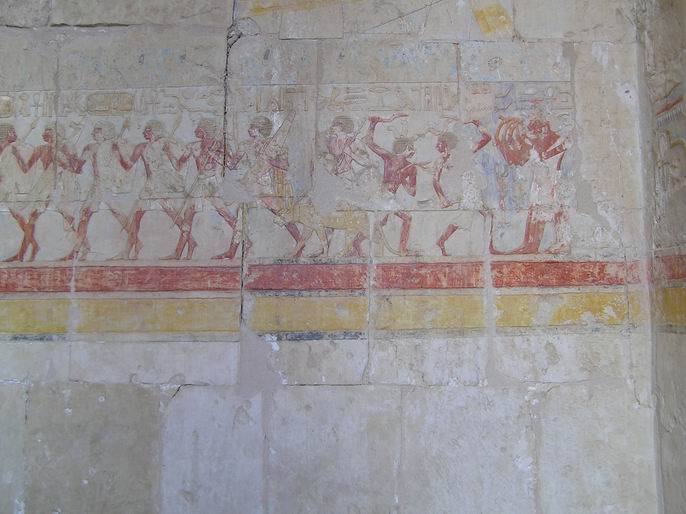
The 2nd terrace is now accessed by a ramp; originally it would have had stairs. The famous Punt relief is engraved on the southern side of the 2nd colonnade. The journey to Punt (now called Somalia) was the first pictorial documentation of a trade expedition recorded, and discovered, in ancient Egypt; until now. The scenes depict in great detail, the maritime expedition that Queen Hatshepsut sent, via the Red Sea, to Punt, just before the 9th year of her reign (1482 B.C) This famous expedition was headed by her high official, Pa-nahsy, and lasted for 3 years. His mission was to exchange Egyptian merchandise for the products of Punt, especially gold, incense and tropical trees.
To the south there is the shrine of the Goddess Hathor. The court that leads to this chapel has columns, where Hathor, who is shown with a woman’s face and cow’s ears, is carrying a sistrum (a musical tool); on the walls she is depicted as a cow. In this part of the Temple, King Tuthmosis III erased the Queen’s names.

On the northern side of the 2nd colonnade, there is a scene depicting the divine birth of Hatshepsut. The Queen claimed that she was the divine daughter of Amon Ra to legitimise her rule.

Beyond the colonnade to the North are the chapel of Anubis, God of mummification and the keeper of the necropolis.
 The 3rd terrace is also accessed by a ramp! It consists of two rows of columns, the front ones taking the Osirid form (a mummy form); unfortunately Tuthmosis III damaged them. The columns at the rear, sadly, have all been destroyed; also by Tuthmosis III!

The colonnade, which leads to the sanctuary of the Temple, has also been severely damaged. This sanctuary consists of two small chapels.

In the Ptolemaic period, a third chapel was added to the sanctuary which was also decorated with various scenes, the most remarkable being the ones representing Amenhotep, son of Habo (18th Dynasty) who, like Imhotep from the 3rd Dynasty, was another genius architect from Ancient Egypt.


Support : Creating Website | Johny Template | Mas Template
Copyright © 2011. For Everything - All Rights Reserved
Template Created by Creating Website Published by Mas Template
Proudly powered by Blogger